

Multilingualism on websites allows content to be displayed in multiple languages, giving visitors the opportunity to view information in the language closest to them. This creates a better user experience, increases trust in the brand and opens the door to the international market. There's a lot of research on this, some of which are really interesting. Google has given an explanation of how manages with multi-language sites, but also research showing the benefits of such sites.
In addition to contributing to a professional impression, Multilingualism also brings many practical advantages – from better positioning in search engines (SEO) to greater reach and number of potential customers.
In order to retain old clients and attract new ones, various methods are used today, from quality use AI-I for texts, good designs, good choice key terms, good meta description, choosing the right ones color i typography, and the general avoidance of design and technical mistakes on the web and multilingualism.
Multilingualism involves carefully translating all content, including texts, titles, menus and metadata. It is recommended that each language has its own specific version of the page (e.g. /hr/ for Croatian, /en/ for English), which allows precise indexing on Google. To change the language, the menu or flag mark is most often used, and in the technical background it is necessary to set the so-called. hreflang tags to enable search engines to correctly identify language versions.
Well-performed multilingualism is not just a translation of existing content – it is an adaptation of language, culture and message to the target market, which significantly increases the performance and reach of the business.
What is automatic and what is manual translation?
Automatic translation
Automatic website translation allows content to be available to visitors from different countries, without the need for each version to be translated manually. Such a system uses Google's translation tool, which automatically translates text as soon as the user chooses another language. For example, when someone selects English or German, the system ‘reads’ the text written in the original language and immediately displays the translated text.
It is important to know that these translations are not saved to the page itself. They only exist while the user is watching the translated version, which means that the text is not stored permanently. In other words, multilingualism is temporarily displayed, and the original version remains the only one really written on the web.
Because of this, no real, separate versions of the website are created for each language. For example, if you have a page in English, the tool will not make a special English version with an address mojastranica.com/en/ nor the German version mojastranica.com/de/. Everything remains at the same address and the translation is only displayed ‘on the go’.
This mode has one important limitation: search engines like Google can't see these translations. They read only the original text of the page, because the translation is displayed only later, when the user opens the page. This means that Google only sees the Croatian version, while the translated versions remain ‘invisible’. The consequence is that the page does not appear in search results in other languages, which limits the actual appearance of the page in search engines.
The same applies to meta descriptions – short sentences displayed under the page title in the search results. They are located in the technical part of the page, which these basic translation tools cannot change. That is why the meta description remains only in the original language, regardless of the fact that the visitor sees the translated text.
Manual translation
When multilingualism is created in such a way that it has specific versions for each language, it is not a simple automatic translation, but a the Right System of Multilingualism. In this case, each language version exists as a separate page, with its own texts, titles and descriptions. For example, the Croatian version may have an address mystranica.com/, English mojastranica.com/en/, and German mojastranica.com/de/.
The advantage of such an approach is that any version can have Fully customised content. The text is not automatically translated, but written and edited separately for each language. This means that you can change the title, add appropriate phrases, and even adjust the tone of communication to the language and culture of the visitor. This way of working brings a much better impression of professionalism and increases the comprehensibility of the content.
One of the great advantages of this way of creating a multilingual site is that it can be edited and meta descriptions – short texts displayed as search results for multilingualism under the page title. For each language version, a specific meta description and title can be entered, so that users see the description in English in their search, and those who search in German – the description in German.
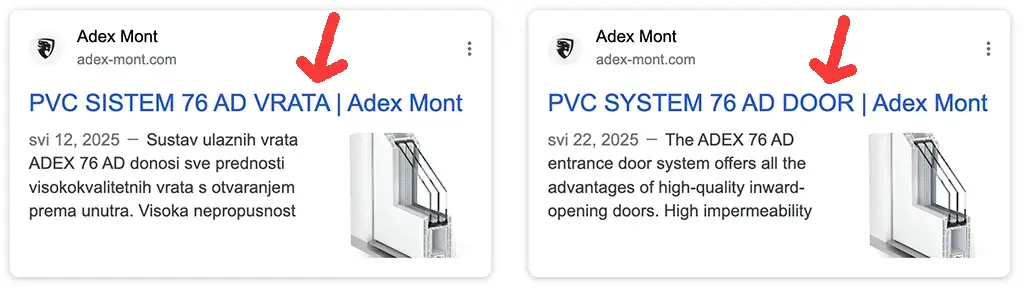
In addition to improving the appearance of results in the browser, this also plays an important role for SEO, as Google can recognize each version of the site as stand-alone. In this way, each language version has the possibility to appear in the search results for its own language and its own market. This is how it is achieved true multilingualism, which not only makes it easier for visitors to view the content, but also increases the visibility of the site on the internet.
Unlike simple systems that only temporarily display translation, this approach creates real subpages for each language. This allows full control over content and SEO settings, meaning that the site owner decides for himself what each language will look like – from title and text to descriptions and keywords.
Ultimately, this way brings a more professional and stable basis for international performance. The multi-language page is not only a technical solution, but also an opportunity to present each page visitor in his or her own language, with a message tailored to him or her.
Comparison and conclusion
| Type of translation | Automatic translation | Manual translation |
|---|---|---|
| Method of translation | Text is automatically translated using Google Translate when the user changes language. The translation is not done permanently. | Each page is manually translated or edited for each language separately. The text is stored as a separate version of the page. |
| Page layout and structure | All versions share the same web address (no /en/, /de/ and the like). | Each language has its own address, e.g. /en/, /de/, /it/. |
| Visibility on Google (SEO) | The translated versions of Google do not see, because the text is translated temporarily. The page is displayed in the original language only. | Google sees each version as a separate page. Each language can appear in searches in its own language. |
| Meta titles and descriptions | It is not possible to translate, because the metadata is not visible with automatic translation tools. | Each language has its own title and meta description, which significantly improves SEO. |
| Quality of translation | The translation is quick, but often incorrect or stylistically unnatural. | The translation is accurate and adapted to the language, culture and terminology of the user. |
| Edit content | Automatic translations cannot be manually edited. | Text, images, titles and descriptions can be fully customised for each language. |
| Speed of implementation | Very fast – the tool is only added and activated on the page. | It is necessary to duplicate pages and translate content, so the process takes longer. |
| Cost of production | A cheaper solution because a convenient tool is used without additional translation. | More expensive because it is necessary to make duplicate pages and add translations for each language. |
| Maintenance | No need for additional maintenance – translation is always generated automatically. | Each language version needs to be updated and synchronised manually. |
| Real multilingualism | Partial – the visitor sees the translation, but Google and other systems do not. | Complete – each language version is self-contained and fully optimised. |

 EN
EN  HR
HR  DE
DE