
The content of the website is today practically the most important for any serious company, craft or other business entity that wants to make a website. However, the mere fact that a business has a website is no longer enough. It is important what is on it, how the content is organized and how well the site fulfills its business purpose.
A visitor who comes to the website for the first time should understand in a very short time what you do, what products or services you offer and how to contact you. At the same time, the site must look professional, work well on mobile phones, quickly load and be technically adapted to search engines.
A modern business website is therefore not just a digital business card. She is An important tool for representing business, building trust and reaching new customers.
Below we present the most important elements that a modern business website should contain and explain why each of them is important.
1. A clear explanation of what the company does
The first and most important thing a visitor must understand is what your business does. When someone comes to a website, they shouldn't study a few paragraphs of the text to understand what you're offering. The information should be clear at the beginning of the page.
Instead of general messages like "Quality you trust" or "Your partner for the future", it is more useful to clearly state what the company does and to whom its services are intended.
For example:
‘We produce aluminium and PVC joinery for family houses and commercial buildings.’
is much more informative than:
‘Quality that lasts for years.’
The slogan can be part of the visual identity, but it should not replace clear business information. The visitor should be able to answer a few basic questions from the beginning:
- What does this company do?
- What products or services does it offer?
- Is that what I need?
- How can I find out more or send an inquiry?
The more clearly the business is presented, the less chance a potential client will leave the site because he did not immediately find what he was looking for.
2. Clearly presented services or products
Once the visitor understands what your company is doing, the next thing he wants to know is What you can offer him concretely. That is why products or services should be clearly presented and easily accessible through website navigation.
It is not enough just to provide a list of products. A good description should be explained to the potential buyer what you offer, what are the advantages of the product and why exactly this solution could be good for it.
For example, a company that manufactures and installs PVC joinery can indicate on the homepage:
- PVC windows
- PVC doors
- sliding rocks
- balcony doors
- blinds and mosquito nets
However, just listing the product does not tell a lot to a potential buyer. It is much more useful with each product to briefly explain its purpose and main advantages.
For example: PVC windows
Energy efficient PVC windows for apartments, houses and business premises. Choose the right type of profile, glass and fittings according to the needs of the object.
For more important products or services, it is good to do and separate subpages. Thus, the person looking for PVC windows can immediately find detailed information about the available profiles, types of glass, performance options, maintenance, price and installation itself.
Do not just describe the product – explain its benefit
When presenting a product, it is important to think from the customer's perspective. For example, the manufacturer of PVC joinery can write:
‘Six-chamber PVC profile with three-layer glass.’
This is useful technical information, but it is often more important for a potential customer to explain what this characteristic brings him:
‘Quality PVC joinery with three-layer glass can contribute to better thermal insulation, greater comfort in space and reduced energy losses.’
Technical specifications should certainly indicate when they are important, but it is good to link them to the specific benefit for the customer. A good business website should therefore not only show what the company sells, but also explain why this product or service is useful to a potential customer.
3. Professional and contemporary design
Design is often the first thing a visitor notices when they open a website. Although appearance alone is not enough to make the website quality, professional design creates the first impression of the business and affects the trust of users.
If a website looks outdated, endless or has not been maintained for years, a potential client can get such an impression of the company itself. This is especially important for businesses where the customer cannot easily assess the quality before purchasing or ordering the service.
On the other hand, a modern website does not mean that it must have many animations, effects or visual elements. A good design is not the one that attracts the most attention, but the one that makes it easier for a visitor to find information.
Design should match business
The website of a construction company should not look the same as the website of a hairdresser's salon, law firm, restaurant or manufacturer of PVC joinery.
For example, a PVC window manufacturer can use quality photos of built-in joinery, product details and photos of real projects. Such visual content gives a potential customer much more information than generic photos of windows downloaded from the Internet.
When designing, it is important to take into account: the overview structure of the page, the readability of the text, the appropriate choice of fonts, quality photographs, proper use of colours, sufficient space between the elements, easy navigation and clear display of important information;
Particular attention should also be paid to the fact that the design is not only subordinate to the appearance. If a visitor struggles to navigate, cannot find contact or has to go through unnecessary animations to get information, an attractive design can actually become an obstacle.
A modern business website needs to look professional, but more importantly – it needs to be easy to use.
4. Mobile Appropriateness
Today, websites are visited very often via smartphones. That is why a modern business website should not be made only for a large computer screen, but must be completely adapted for mobile phones and tablets.
Adapting to mobile phones doesn't just mean that content automatically decreases to fit on a smaller screen. The site must be designed in such a way that Easy to use by touch, that the text can be read without magnification and that the user can easily find what he is looking for.
For example, a potential buyer who is looking for a company that installs PVC joinery on his mobile phone should be able to find without problems:, what products the company offers, photos of executed projects, the area in which the company operates, the phone number, the possibility of sending inquiries and basic information about products
It is especially important that they buttons and links large enough and distant enough from each other so that the user can simply press them with his finger.
The mobile version is not just a smaller version of the desktop site
The content on the mobile phone should be adapted to the way users read it. Long passages, complicated menus, small text and unnecessary elements can make the use of the site significantly more difficult.
For example, a phone number on a business website can be made so that the user can call it immediately with one tap. The same goes for buttons like "Send inquiry", "Request a tender" or "Book an appointment".
Before publishing a website, it is necessary to check how it looks and works on different screen sizes, and not only on the computer on which it was created.
If a potential customer on a mobile phone has a hard time using your website, there is a great possibility that you will lose some of the users before they even get information about your products or services.


5. Clear call to action
The website can have excellent design and quality content, but if the visitor is not clear what to do once he finds the information he is looking for, part of the potential clients can simply leave the site.
That is why the website should have clearly defined Call to Action (CTA). Their purpose is to direct the visitor to the next step.
A call to action can be, for example:
- Request a quote
- Send inquiry
- Call us
- Arrange an appointment
- Book an appointment
- See products
- Learn more
Which call will be the best depends on the type of business. For example, a company that manufactures and installs PVC joinery can have a button on its pages:
Request a free quote
while the law firm might be more suited to:
Arrange a consultation
And the car service:
Order for service
CTA should not be aggressive
A clear call to action does not mean that every part of the site should contain a large button calling for purchase. Too many such elements can act offensively and make it difficult to read content. Call to action should appear at the right time, i.e. once the user has received sufficient information to be able to make a decision on the next step.
For example, after presenting the PVC window can stand:
Would you like to know which PVC joinery would suit your property? Request a quote.
The presentation of a service may be followed by:
Want to find out more? Send us an inquiry.
In this way, the CTA is not only a decorative button, but logical continuation of content.
Each page doesn't have to have the same goal.
The home page can direct the user to the main services, the product page to the query, and the contact page to the phone call or form. Before creating a website, you should consider: What do we want the visitor to do after he finds what he is looking for?
If the answer is clear, it is much easier to properly place calls to action throughout the website.
6. Easy and quick access to contact
If the goal of a business website is to get new customers and inquiries, contact information must not be hidden. A potential client who is interested in your service should easily find a way to contact you. On the website, depending on the type of business, it should be available: phone number, e-mail address, contact form, business address, opening hours, location on the map and links to social networks, if the business actively uses them
It is important that the contact is not only on the page "Contact". The telephone number or query button may also be available in other important places, especially after presenting the product or service.

Contact should be tailored to the way the user wants to communicate
Different users prefer different ways of communication. Someone will prefer to call, another will send an e-mail, and the third will fill out a short form. That is why it is good to offer more options, but without unnecessary complexity.
For example, a company that installs PVC joinery can, after presenting its products, offer:
Request a quote
Send us dimensions and basic information about the property, and we will contact you with an offer.
At the same time, the phone number can be clearly visible to users who want to talk to someone from the company immediately.
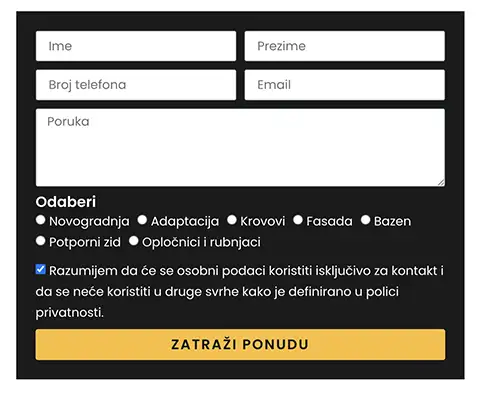
The contact form should not be unnecessarily long
One of the common mistakes is to ask for too much data before the user sends the first query at all. In many cases, they are sufficient: name, e-mail or phone and message. Depending on the activity, specific data necessary for the preparation of the tender may also be added.
The easier it is for a potential client to send a query, the more likely they are to actually send it.
Therefore, contact is not just a technical item to "have" on the website. It is one of the most important parts of a business website if its goal is to turn visitors into real queries and customers.
7. References, projects and reviews
When a potential client first comes to the website, he does not yet know how good you are at what you do. You can write that you have many years of experience, use quality materials or provide superior service, but such claims have a much higher value when you can corroborate with concrete examples.
That is why references, derived projects and reviews are an important part of a modern business website.
For example, a company that installs PVC joinery can show photos of actually executed projects, indicate where the joinery is installed and describe what was done on the project. The potential buyer thus not only sees the photos of the product, but can get an idea of it what the final result of the work looks like.
The same applies to other activities. The construction company can show completed facilities, design studio its projects, photographer specific works, and accounting service experience and recommendations of its clients.
Reviews further build trust
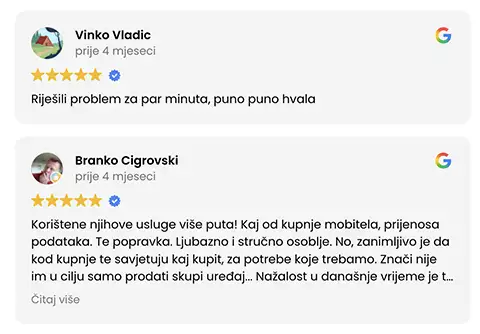
Reviews and recommendations of real customers can be especially valuable because they provide information to a potential customer from the perspective of a person who has already used your service. Instead of a general statement: “Our clients are very satisfied”, it is much more convincing to show the actual review of the client, with his permission and a credible source.
If the company has a higher number of quality reviews, they can be displayed on the home page, but also in other relevant places.
Better a few concrete projects than just general statements
If you have the opportunity to show real results of your work, use it. For example:
Project: Family house in Zagreb
Built-in 12 PVC windows, 2 balcony doors and entrance doors. Selected three-layer glass and anthracite PVC profiles.
Such a presentation to a potential client speaks much more than a sentence:
“We carry out quality work to the highest standards.”
A good business website should not only tell you how good you are – it should show the results of your work wherever possible.
8. Quality photography and visual content
Photos are one of the most important elements of a business website, especially for activities where the result of the work can be visually displayed. Often, before reading a detailed text, the visitor first notices the photos, so they significantly affect the first impression of the business.
If you have your own products, business premises, executed projects or works, quality real photos are almost always a better choice than generic photos from the Internet.
For example, a company that manufactures and installs PVC joinery can show real-life projects, window and door details, different types of performances and photos before and after installation. A potential buyer can thus see what the actual result of the work looks like.
The same applies to construction companies, architects, hairdressing salons, restaurants, apartments, car services, design studios and many other activities.
Photography should have a purpose
It's not enough just to take as many photos as possible. They should help the user to better understand the product, service or business.
For example, a photo of a PVC window can be beautiful, but a photo of a really built-in window in a finished object can give a much more useful information to a potential buyer.
Product details, materials and different designs can be displayed. In the case of services, the work process and the final result can be shown. In a business space, photography can help create an impression of professionalism and trust.
Don't overlook the quality of the photos.
Dark, blurry, poorly framed or completely different photos can make a bad impression even when the business itself is quality. On the other hand, quality and well-chosen photos can significantly raise the impression of the entire website.
This does not mean that every company must hire a professional photographer for every new photo. It is important to think before publishing what the photo should show and what message it sends to the potential client. Photos should also be technically optimized so as not to unnecessarily slow down the website. In the image below you can see the original image that has 2 MB and an optimized image that has 200kb.



9. SEO basics
A quality business website is not only intended for people who already know the name of your company. It is important that potential customers can also find it when they type in Google a product, service or problem they are trying to solve.
That is why the website should have a quality basis for SEO, or search engine optimization.
This does not mean that the creation of the website itself will automatically bring the page to the first place of Google. SEO is a long-term process influenced by a number of factors, including competition, content quality, site authority and technical quality of the web. However, already when creating a site, it is necessary to lay good foundations.
What do the basic SEO elements include?
Depending on the project, this may include:
- Proper structure of titles and sub-headings
- Quality and relevant texts
- the corresponding URL of the address
- SEO titles and meta descriptions
- optimized photos
- internal linking of pages
- proper indexing
- XML sitemap
- Appropriate structure of the website
- technical optimisation
- Basic loading speed optimization
It is particularly important plan the structure of the website before its creation, and not only after publication try to add SEO elements.
For example, if a company installs PVC joinery, it is not the same to have one page that only mentions ‘PVC windows, PVC doors, sliding walls and shutters’, or to have clearly structured pages that present individual products in detail and answer questions from potential customers.
SEO is not a promise of first place on Google
When choosing a website, it is important to distinguish between SEO-friendly website creation from long-term SEO work. A good website can be technically and substantively prepared for search engines, but this in itself does not mean that it will be the first for every desired keyword.
10. Quick loading of the website
If a visitor has to wait too long for a few seconds before the content appears, there is a great possibility that they will give up and look for information on another page.
The speed of the website is therefore not just a technical issue. It directly affects User experience, and in the case of business websites, it can also affect the number of inquiries made.
Loading speed can be influenced by a large number of factors, including: size and format of photos, hosting quality, quantity and way of loading scripts, unnecessary add-ons and functionalities, way of creating a website, code optimization and use of cache and other optimization techniques
A special problem can be large photographs. A photo taken with a modern camera or mobile phone can have several megabytes, although it occupies only part of the screen on the website. If such photos are placed without optimization, the site may unnecessarily transfer large amounts of data.
A quick page is not the same as a simple page
It is important to emphasize that a fast website does not mean that it must be completely simple and without functionality. A modern website can have quality photos, galleries, patterns, animations and other functions, but they must be technically well-implemented and optimized.
The goal is not to remove everything that makes a website interesting, but to find a balance between appearance, functionality and speed.
11. Safety and regular maintenance
The website has not been created once and for all. Especially in systems such as WordPress, it is necessary to regularly maintain the platform itself, add-ons and other components in order to keep the site safe and functional.
Security is important even when products are not sold through the website and sensitive data is not collected. An attacked or compromised website may be used to disseminate unwanted content, redirect visitors or other problems that may damage the reputation of the business.
What should maintenance include?
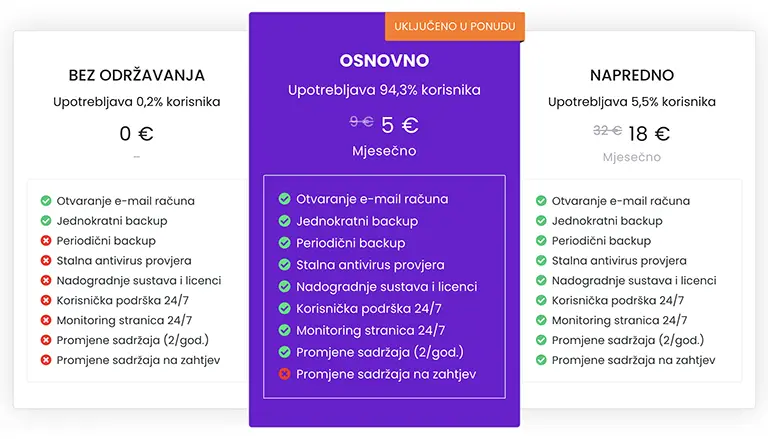
Depending on the type of website, maintenance should include: regularly updating the system and plugins, security checks, making backups, monitoring the operation of the website, solving technical problems checking forms and other functionalities and removing unnecessary or outdated plugins
It is especially important to have Backups that can be returned in case of a problem. If an error occurs after an upgrade or a security incident, a quality backup can significantly facilitate and speed up site recovery.
Who will maintain the website?
Before creating it, it is good to clarify what happens after the publication of the site. Some web companies offer maintenance as a separate service, while others allow the client to manage the site himself. Both options can be good. It's important that you know in advance. who is responsible for the maintenance, what is included in the service and how much it costs.
Also, maintenance does not just mean updating WordPress. If prices, services, contact details or other important elements change on the page, it is necessary to ensure that the content remains up to date.
A website that has not been maintained for years may pose risks to both business and users.
12. Easily edit and update content
The business is changing, and with it the content of the website is also changing. You may introduce a new service, change your opening hours, add a new product, change your price or want to publish a new reference. That is why a modern business website should be enabled Easy content management.
For most companies, it is not practical to hire a web developer every time one sentence or photo needs to be changed.
For example, a PVC carpentry company can add a new window model during the year, change information about available profiles, or post photos of a new project. Such changes should be possible without an unnecessarily complicated procedure.
Easily editing doesn't mean everyone has to know how to program
Modern content management systems allow much of the changes to be made without writing code. The user can edit texts, photos, pages and other elements through the administration interface. Of course, for more complex changes and technical interventions, it is still useful to have professional support.
13. Follow-up of visits and results
The website may look great, but without data it's hard to know how useful your business is. It is not enough to know just how many people have visited the website. It is much more useful to understand what these visitors do after coming to the site.
For example, you can follow:
- how many people visit the website
- Where visitors come from
- which pages are most frequently viewed
- which services attract the most interest
- how many people send a contact form
- how many users click on a phone number
- through which the search comes to the page
- which pages bring the most queries
Different web analytics and results tracking tools can be used for this, depending on the needs and the way the website is set up.
Visits are not the same as results
The large number of visits per se does not mean that the website does its job well. For example, a site can have 10,000 visitors a month, but if no one sends a query or calls the company, the question is how much these visits are actually worth.
On the other hand, a smaller business website can have several hundred relevant visitors per month and make a significant number of inquiries from them. That's why it's important to keep track of your business website what is really important for business.
If the goal is to get more phone calls, you should track the calls. If the aim is to receive tenders, the submitted forms should be followed. If the sale takes place through a website, the purchases made should be tracked.
Data can also help improve the website
Analytics are not only useful for measuring results. Data can also show where there are problems. If a large number of users visit the site of a particular service, but very few of them send a query, content, offer or call to action may need to be improved. If users often leave the page at a certain step, there may be a problem with the navigation or the way the content is presented.
14. Quality content that answers customer questions
The website should not only contain basic information about e.g. the grooming salon and the treatment list. Potential clients often have many questions before they decide to book an appointment. Quality content should help them to find answers as easily as possible and gain confidence in the salon.
For example, a beauty salon may have content that answers questions such as: What facial treatment suits my skin type? How long does the treatment last? How often should treatment be repeated? How to prepare for a specific treatment? What should be avoided after treatment? What is the difference between different types of treatment? How long does recovery take? Is the treatment suitable for sensitive skin?
Such information can be especially useful to a person who is thinking about a treatment for the first time and is not yet sure what to choose.
Don't just list the treatments.
A common mistake is to make a page that only says:
Facial treatments – €40
Manicure – €25
Pedicure – €30
Lash lift – €35
The price list is important, but in itself it does not provide enough information to a potential client.
It is much more useful with every important treatment to explain who it is intended for, what it includes, how long it lasts and what kind of result can be expected.
For example:
Deep facial cleansing
Treatment designed to cleanse the skin and remove impurities. It is suitable for people who want to refresh the appearance of the skin and improve its cleanliness. The treatment lasts approximately 60 minutes.
In this way, the client receives not only the name of the treatment and the price, but information that helps him to decide whether this treatment is exactly what he is looking for.
Content can also help you find a salon on Google
If a person in Google enters a question such as ‘which facial treatment to choose for oily skin’, a page that answers that question well is more likely to be useful to it than a page that merely mentions ‘face treatments’.
Therefore, content on a business website should not be created solely for search engines. First, it should be useful for real customers., and good SEO and AI optimisation can then help you find that content.
15. Frequently Asked Questions and Answers
If potential clients often ask the same questions, there is no reason to have to ask for answers every time by phone or e-mail. Section Frequently Asked Questions (FAQ) can easily resolve a large part of the concerns before the user decides to send an inquiry or order a service.
For example, a beauty salon can answer questions such as:
- How long does the treatment last?
- Should I order in advance?
- Can I cancel my appointment?
- How to prepare for treatment?
- How often should treatment be repeated?
- Which treatment is best for my skin type?
- Can I combine multiple treatments?
- What payment methods do you accept?
Such questions can also be useful in other activities. The construction company can explain how long the offer lasts, the law office what the first meeting looks like, the car service how long a certain service lasts, and the manufacturer of PVC joinery what the measurement and installation process looks like.
FAQ should not be just a list of questions
A good FAQ section should not contain answers written just to make the page have as much text as possible. Questions should arise from Real customer concerns.
If clients often ask:
‘How much in advance should I book an appointment?’
this is a good reason for the answer to be found directly on the website.
This saves the user time, but at the same time reduces the number of unnecessary phone calls and messages.
FAQ can also help with Google Search
Well-written questions and answers can include specific queries that people type in search engines. For example, a person may not only look for a "beauty salon Zagreb", but:
"How long does the lash lift last?"
"How to prepare for chemical peeling?"
"How often is facial treatment done?"
If your website gives a quality and clear answer, there is a possibility that it is through such content that it attracts a potential client.
The best FAQ is not the one that has the most questions, but the one that answers the questions that clients really ask.
16. Clearly highlighted information about the company
A potential client often wants to know before making a decision who is behind the business. Especially when it comes to a higher-value service, a long-term business relationship or a business where trust is important. That is why the business website should not only explain what the company sells, but also provide basic information about the business itself.
This may include: name and basic information about the company, location and area of activity, how long the company has been operating, experience and expertise, number of employees, if relevant, certificates and licenses, business partners, awards and recognitions, photos of the business premises or team and other information that can increase trust
Of course, it is not necessary to publish all of the above on the site. It is important to choose the information that is relevant to the specific activity and decision of the potential client.
People want to know who they're dealing with.
Let's imagine two companies that offer the same service and have a similar price. One on the website has only a list of services and a contact form, while the other shows its team, real projects, experience, certificates and several reviews of satisfied customers. The second company gives the potential client more reasons to trust.
This is especially important for services where no decision is taken immediately. The client may not send an inquiry when visiting the site for the first time, but a well-presented company can make a much better impression and increase the likelihood that it will come back later.
Don't exaggerate yourself with praise.
The page "About us" should not be just a series of sentences such as:
"We are the best, the highest quality and the leader in our industry."
They are much more convincing Specific information and evidence.
For example:
“We have been operating in Zagreb since 2012. To date, we have carried out more than 500 PVC and ALU joinery installation projects."
Such information tells the potential buyer much more than a general statement about years of experience.
17. Local visibility and clear location
If the company operates in a certain area, the website should clearly show where the service is provided. This is especially important for crafts and companies that work in one city, county or in a limited area.
For example, a company that installs PVC joinery may be operating in Zagreb and its surroundings, while a beauty salon can only receive customers in one location. It is important for potential clients to know immediately whether the service is near them. The website should therefore clearly state: business address, city and area of operation, opening hours, telephone number, location on the map, where useful and the areas or cities where the service is provided
Location may also be important for Google
When a user searches a local service, Google tries to show results that are relevant to him by location and query.
That's why it's not the same to have a page that just says:
"We are installing PVC joinery."
and a page clearly explaining:
‘We are installing PVC joinery in Zagreb and Zagreb County.’
If the company works in several areas, it is possible to present individual locations in more detail, but it is necessary to avoid creating a large number of almost identical pages just because of attempts to get better positions on Google.
The location should be clear to the user
Local visibility is not just SEO. If a potential client finds your site but can't find out quickly where you are or whether you are coming to its location, some interested users may opt-out.
This is why it is useful to also link location information to practical information.
For example:
The salon is located in the center of Zagreb, and it can be reached by public transport. Parking is available in the immediate vicinity.
Such information can be much more useful to the user than the address itself.
18. Legal and mandatory information
A business website should not only be beautiful and functional. Depending on how you do business and what data you collect, it is also necessary to take into account legal information and obligations relating to the website.
This is especially important if you collect information through contact forms, enable online shopping, bookings, sign up for a newsletter, or use different technologies to track users. Depending on the business, the website may need to contain information such as: name and basic information of the business entity, contact information, registration information, when applicable, privacy policy, information about the use of cookies, terms of use or business terms of purchase and delivery, if sold through the web, information about returns and complaints, when applicable
For web shops and other more complex websites, the obligations can be much more extensive than for a simple presentation page.
It's not enough just to put a few documents in the footer
It is important to understand that legal information is not just a formality to be added at the end of the page. If, for example, the website collects personal information through the contact form, the user should be clear what information is collected, why it is collected and how it is handled.
The same applies to cookies and other technologies that may collect or process user data.
The responsibility of the owner of the site is also important here
The web company can technically set certain elements, but this does not mean that it takes legal responsibility for the content that is published.
If necessary, it is best to use it to create legal documents and verify compliance Professional legal advice, especially in web shops, booking systems and other businesses that process large amounts of personal data.
19. Possibility of further development of the website
The website should not be made just for the needs you have today. The business is changing, and together with it, the needs of the website can also be changed. Today you may only need a presentation page with several subpages, but in a year or two you may want to add:
- New services or products
- blog and educational content
- multiple languages
- online reservations
- Possibility to send a request for quotation
- Product Catalogue
- online sales
- Connection with other business systems
- Additional functionalities for users
That is why when creating a good thinking that the Website should monitor the development of business
A good example are bookings. The beauty salon may receive orders today only by phone, but later it may wish to allow customers to book an appointment online. A simple contact form may be enough for the apartments, and later there may be a need for its own reservation system.
Therefore, before making it, it is worth considering:
‘What could I need on the website in two or three years?’
You don't have to create everything you might be able to use one day right away. But it is good that the basic structure is set so that the website can be upgraded.ti at least a few steps in advance. Therefore, it is necessary make sure that the price The site also meets the requirements for modern business.
How many elements does a modern business website really need?
Not every company needs all 19 elements to the same extent. The website of a small craft, manufacturing company, beauty salon, law office or tourist facility can have completely different needs and therefore different price.
For example, local crafts may be the most important Clearly presented services, location, contact and references, while the web shop will need a completely different structure and additional functionalities. The beauty salon can be of great benefit online booking, while it may be more important for the construction company to present the completed projects and references well.
That's why a modern website doesn't necessarily mean a large number of functions and subpages. On the contrary, unnecessary functionalities can make the site more expensive, complicated and difficult to maintain.
A good website should be simple enough for the user to easily navigate it, but at the same time high-quality and flexible enough to support the business.
A modern website is not just a beautiful design
When it comes to creating a website, often the greatest attention is paid to design. Of course, appearance is important because it creates the first impression, but Design is only one part of the whole project. A beautiful website that does not bring queries is not necessarily a good business website. Also, a site that is technically perfect, but does not explain to the visitor what the company offers, will not achieve its full potential.
The goal of a modern business website should be much wider: present the business, build trust, help the potential client make a decision and make it easier for him to take the next step.
Conclusion
A modern business website today is much more than an online business card. It is often the first place where a potential client comes into contact with your company, so it must make a professional impression, quickly convey the most important information and allow for a simple next step.
It is not the most important thing to have as many functionalities, animations or subpages as possible. It is more important that the website tailored to the specific business and needs of its clients.
A well-designed business website needs to answer a few simple questions:
Who are you? What do you offer? Why would a client choose you? How can he contact you?
If it gives clear answers to these questions, if it loads quickly, works well on mobile phones, is easy to maintain and has a good basis for Google, the website can become much more than a place where basic information about the company stands.
It can become a tool that actively participates in finding new clients and developing business.
If you are just choosing who will create your new business website, it is important to check, in addition to the price, what is included in the offer, what the creation process looks like, who maintains the site and what you get after publication. How to choose a web company to create a website, you can look at here.
Frequently Asked Questions
How many pages should a modern business website have?
There is no universal number. A small company can do quality business with several well-structured pages, while a larger business may need separate pages for products, services, locations, references and other content. It is more important that the structure is business-friendly than that the website has a certain number of subpages.
Does a modern website have to be mobile-friendly?
Yes, yes. The website should be adapted to different screen sizes and easy to use on smartphones, tablets and computers. The mobile version should not only be a reduced version of the desktop site.
Should every business website have a blog?
Not necessarily. A blog makes sense if the company has useful topics on which it can write regularly and if such content can help users or attract relevant visitors from search engines. It is not necessary to have a blog just because it has other websites.
Should a business website have SEO?
Yes, at least a quality SEO basis. Page structure, content, titles, URLs, photos, indexing and other technical elements should be properly placed. However, the very creation of a SEO-friendly website does not automatically mean high positions on Google.
How important is the speed of the website?
It is very important because it affects the user experience. Large photos, poor hosting, unnecessary functionalities and poor technical performance can significantly slow down the page. The goal is to achieve a good relationship between design, functionality and speed.
Should prices be displayed on the website?
Depends on the business. For some products and services, price is very important information and its clear display can increase trust. In more complex services, where the price depends on the specific requirements of the client, it is better to explain what affects the price and offer the possibility of sending a query.
Should the website have a contact form?
In most cases yes, especially if one of the goals is to get new queries. The form should be simple and only look for the information that is really needed. Along with it, it is useful to clearly show the phone number and other means of contact.
How often should a website be upgraded?
There is no specific deadline after which the website needs to be completely created from scratch. Content and functionalities need to be updated regularly, while major reconstruction works when the site no longer fits business needs, looks outdated or is technically difficult to sustain.

 EN
EN  HR
HR  DE
DE