

In recent years, the way websites send e-mails has changed significantly. What used to be simple and almost imperceptible today becomes an important issue for website owners, webshops and online services. Many hosting providers have started to abolish the older way of sending emails through the so-called PHP mail functions, which In many users, it causes confusion and the question of whether something should be changed on their pages.
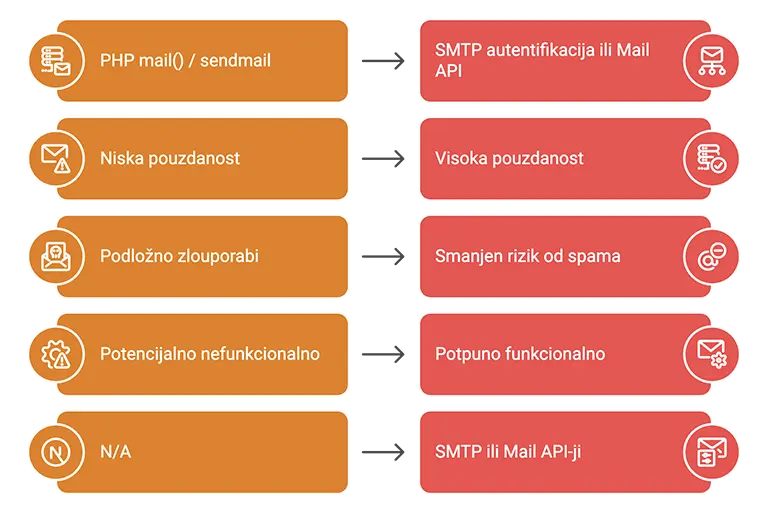
In practice, this means that the website more cannot automatically send messages in a way that has been considered standard for years. Contact forms, order confirmations, user registrations, password resets and various automatic notifications often worked through a simple system embedded in the server. This system was practical because it did not require additional adjustments, but over time it became problematic due to the large amount of spam and abuses.
Email security
Today, the Internet relies much more on security, identity verification and reliability of communication than it did ten or fifteen years ago. That is why many hosting providers no longer want to allow anonymous messaging from their servers. Such messages often end up in spam folders or are completely blocked by large services like Gmail and Outlook. Users then have the feeling that the website is working properly because the form shows a message that an e-mail has been sent, but the message never actually arrives at its destination.
That is why today we are increasingly moving to a more modern way of sending e-mails such as SMTP, where the website connects to a real mail account or a specialized messaging service. Such an approach provides greater security, better delivery and greater control over communication. In other words, the system must prove that the message was indeed sent from a legitimate website and not from a spam system or malware.
For website owners, this change may sound technical and complicated, but in most cases it is about relatively simple adaptation on SMTP. For modern websites, it is enough to properly link the sending of e-mails to an existing e-mail account or activate an additional messaging authentication system. After that, contact forms and automatic notifications work normally again, often even more reliably than before.
This change is especially important for webshops and business sites. If the customer does not receive an order confirmation, if he can not reset the password or if the query sent through the contact form never arrives to the site owner, this can create a serious problem in the business and leave the impression of unprofessionalism. Many site owners are not even aware that some of their messages have been ending up in spam for months or are not delivered at all.
That is why today the modernization of the email system is considered almost standard part of website maintenance. Just as security systems, plugins and site design are regularly updated, the way emails are sent must follow modern internet standards. The goal is not only technical adaptation, but also to ensure reliable communication between the website and the user.
For end users, this change will generally not be visible, but will result in safer and more stable operation of the website. Messages will arrive in the main inbox more often than in spam, communication will be more reliable, and the risk of abuse will be significantly lower. That is why hosting providers are increasingly introducing such changes and encouraging website owners to switch to more modern email systems.
What is SMTP?
SMTP (Simple Mail Transfer Protocol) is a standard protocol used to send e-mail messages between servers in computer networks. It allows the transmission of e-mail from sender to recipient via the internet. When a user sends an email from programs such as Microsoft Outlook, Mozilla Thunderbird, or a mobile application, the message is first sent to the outgoing mail server, which then forwards it to the recipient's target server.
SMTP has several key functions that allow you to send emails reliably. First of all, it serves to send messages from the user's device to the mail server, that is, it ensures the initial step in the process of delivering e-mail. It also supports authentication, which means that the user must verify their identity before sending messages, thereby increasing security and reducing the possibility of misuse of the system.
In addition, SMTP allows you to send different types of content within email messages, including text, images, documents, and other attachments. After the message arrives on the outgoing server, SMTP is also used for its further forwarding to the respective recipient's server, until the email is delivered to its inbox.
Why is SMTP important?
SMTP is essential for the functioning of e-mail as it allows sending e-mail messages between different mail servers. Without SMTP, e-mail communication would be impossible. For persons who lead online store or using different hosting services, such as WordPress hosting, SMTP is an indispensable element of IT infrastructure.
SMTP is an essential element of the e-mail infrastructure that enables the efficient sending of e-mail messages on the Internet. Cooperation with other protocols, such as POP3 (for receiving e-mail messages) and IMAP (for accessing mailboxes on the server), ensures comprehensive support for e-mail.
SMTP as standard
U InsertioWebu We approach these changes as a standard part of creating and maintaining modern websites. Instead of outdated emailing methods that are increasingly being cancelled or restricted, all projects we set up so that they use a reliable and stable system based on verified mail services and secure authentication.
In practice, this means that any contact form, webshop function or automatic notification from the website is not left to chance, but is technically adjusted so that messages really arrive at their destination. This avoids situations where users do not receive a response or site owners do not see the queries sent, which is one of the most common problems in older solutions.
Such an approach is not an additional option today, but standard in the professional development of websites. In addition to increasing the reliability of email delivery, it also provides a better reputation for the domain itself, which means that messages rarely end up in spam. This is especially important for business systems where communication with customers must be fast and secure.

 EN
EN  HR
HR  DE
DE