
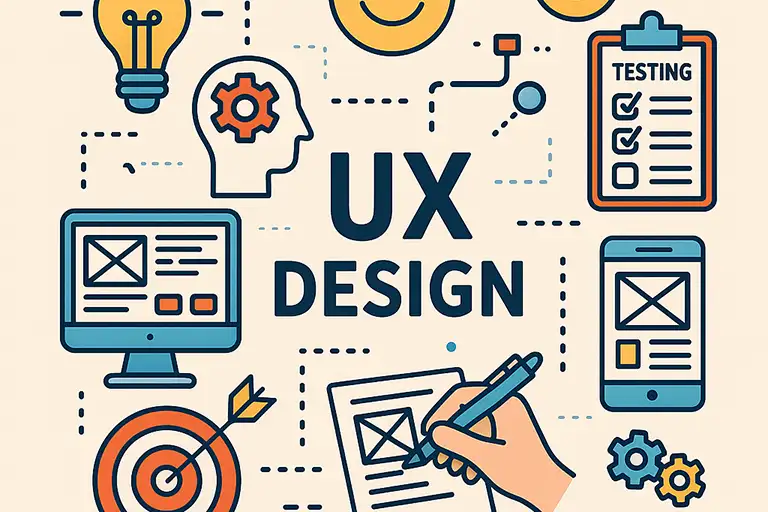
What is UX design and why is it important?
UX Design (abbreviated from User Experience Design or User Experience Design) represents the process of designing products – either digital (such as websites, applications, software), or physical (such as devices or interactive kiosks) – that provide users with a meaningful, intuitive and enjoyable experience of use. The key purpose of UX design is to optimize the way the user experiences the product throughout the interaction, from the first contact to the end of the user journey.
In other words, UX design is not just a question of appearance, but of feeling: How easy is it to use something? How fast and clear is it for the user to achieve the goal? How satisfying is the whole process?
What does UX design cover?
the UX Design interdisciplinary field It combines knowledge from psychology, design, technology and business to create products that are functional, intuitive and emotionally satisfying for the end user. In the focus of UX design is the whole User Path (user journey), i.e. all the stages the user goes through – from first contact with the product, through use, to support after purchase.
The key components of the design are explained in detail below:
Usability
Usability indicates how easy a product is to use.
- Can the user quickly understand how to use the product without the need for additional instructions?
- Is the process of executing a task (e.g. online shopping, booking, downloading a document) logical and without unnecessary steps?
- Does the user have a sense of control and clarity at all times?
- Is the interface predictable and consistent?
Good design reduces cognitive burden – the user should not feel lost, confused or frustrated when using it.
Accessibility
Accessibility means designing a product so that it can be used by all people, regardless of their physical, cognitive or technological capabilities. This includes:
- Enabling the use of persons with disabilities (e.g. visually impaired people use screen readers).
- Use contrasting colors, legible fonts and plain language.
- Navigation that is possible through the keyboard, without relying solely on the mouse.
- Ensuring that all important functions are also available at mobile devices, not just on desktop.
Inclusive design not only respects the diversity of users, but also contributes to greater reach and satisfaction.
Functionality
Functionality indicates the technical correctness and reliability of the product – does everything work as it should? Designers ask questions like:
- Does the behaviour of the system match the expectations of the user?
- Does the system have bugs, interruptions or unclear error messages?
- Are all functions easily accessible and properly connected?
Without reliable functionality, even the most beautiful design loses meaning because the user cannot achieve his goals.
Value (Value)
Value refers to how much the product contributes to the life of the user. The key question is: "What specific user problem does this product solve?" The value is expressed in:
- Save time, money or effort.
- Facilitating complex tasks or automating repetitive processes.
- Emotional needs (e.g. feeling secure, connected, entertained).
- Providing a better solution compared to the competition.
Users quickly identify useful products – the UX design must communicate this value clearly and in a timely manner.
Emotional impression
UX design does not stop working – it is important and Emotional response which product it provokes. People often make decisions based on feelings, not just logic. Good UX design therefore:
- It causes positive emotions such as satisfaction, trust, surprise or joy.
- Creates a sense of connection to the brand or app.
- It avoids frustration, uncertainty and doubt through clear communication and support.
The emotional aspect plays a key role in the Formation of Customer Loyalty – users return to products that have made them feel good.

Stages of design
User Research
User research represents the fundamental phase of the UX process. At this stage, the aim is to understand in depth end-users – their real needs, habits, expectations, as well as the challenges and frustrations they experience when using products or services.
In order to obtain a complete insight, different qualitative and quantitative methods are used. Interviews with users provide direct insight into their experiences, way of thinking and behavior. Surveys are used to collect data from a larger number of users, which helps to spot patterns and draw conclusions based on statistics. The focus of the group enables thoughtful discussions with multiple users at the same time and reveals how people respond to ideas in a group environment. Observing users in real-life situations reveals behaviors that they might not verbalize themselves, while usage analysis tools, such as Google Analytics, Hotjar or Mixpanel, provide information on where users encounter obstacles and in which part of the interaction problems arise.
This stage is extremely important because without a thorough understanding of real users and their behavior, all further design steps remain at the level of assumptions. And a UX design based on assumptions, not insights, cannot provide a quality and meaningful user experience.
Defining Problems and User Needs
Defining Problems and User Needs the second phase is the UX process, which builds on user research. Based on the collected data, so-called ‘persone’ are created – fictitious but realistic profiles representing different types of users. Each persona contains information about demographic characteristics, motivations, goals, behaviors and challenges of users.
In addition, user journey maps are created, showing all the steps the user goes through when interacting with a product or service – from first knowledge to use and possible support. These folders help to detect points of frustration, opportunities for improvement and emotional reactions of users at each stage. Parallel to this, the problem is defined, that is, clearly articulated formulations of specific problems that users experience.
This stage is extremely important because it allows the design team to understand precisely what needs to be solved. Without a clear definition of the problem, design solutions risk being focused on the wrong aspects or not responding to the real needs of users. Well-defined problems also serve as a basis for setting measurable design targets, allowing the performance of future solutions to be monitored.
Ideation represents the creative phase of the UX process in which, based on pre-defined problems and user needs, different ideas and potential solutions are generated. This phase does not immediately seek the perfect solution, but encourages free, open and diverse thinking with the aim of exploring as many possibilities as possible.
The idea often uses different techniques that encourage creativity and collaboration within the team. One of the most common methods is brainstorming – a structured group process of generating ideas without condemnation or criticism, encouraging free expression and exchange of views. The Crazy 8s technique uses a time limit to encourage the quick visualization of eight ideas in just eight minutes, thus avoiding perfectionism and opening up unexpected solutions. The SCAMPER technique helps to modify existing solutions through systemic issues (e.g. what could be replaced, combined, adapted, eliminated). In addition, design thinking workshops are often organized, in which teams jointly explore user challenges and develop innovative, user-oriented solutions.
This phase is important because it allows for so-called divergent thinking – expanding the spectrum of opportunities before narrowing down the choice. This avoids premature conclusions and encourages the development of solutions that can be more innovative, efficient and better adapted to users.
Wireframing and prototyping
Wireframing and prototyping indicate the stage at which abstract ideas move from the conception stage to the visual and functional form. The goal of this phase is to turn solutions into concrete models that can be analysed, tested and refined before resources are invested in full product development.
Wireframe is a rough sketch of the user interface, without visual effects, colors and stylization. Its purpose is to show the basic structure of pages or screens – where buttons, texts, images, menus and other key elements are located, in order to test the layout logic and flow of user interaction.
Wireframe is followed by prototyping, which can take place on two levels of complexity. Low-fidelity prototypes are often made on paper or in simple tools, and show basic functionalities without much detail. High-fidelity prototypes, on the other hand, include realistic elements and are often interactive – they allow the user to click, move through the interface and simulate actual use.
At this stage, various digital tools are used that allow a quick and efficient prototyping. Among the most famous are Figma, Adobe XD, Sketch, Axure and InVision – each of them allows teamwork, commenting, connecting prototypes into a user stream and preparing for testing.
This phase is crucial because it allows for early testing and validation of ideas with users without the need for technical implementation. This significantly saves time, money and effort because potential problems can be detected and corrected at a stage when the changes are still simple and inexpensive to implement.
Testing
Usability Testing represents the stage at which the prototypes produced are tested with end-users to determine how functional, understandable and user-friendly the solutions are. Testing is carried out through simulated tasks, where users try to perform certain actions within the prototype – such as finding a product, filling out a form or making a purchase.
The aim of the testing is to identify where users encounter difficulties, collect quality feedback and find out if the design solutions are intuitive and meet the needs of users. Feedback can be qualitative (e.g. user comments and observations during use) or quantitative (e.g. time needed to complete the task, number of wrong clicks or percentage of successful interactions).
Testing can be done in several ways. Moderated testing involves the presence of a UX expert who directs the user and records his reactions, while non-modern testing is carried out remotely, often through digital tools that automatically record the user's behavior. At a stage where there are multiple versions of the same solution, it can be used A/B testing, where two interface variants are compared to determine which works better in the real environment.
Testing is extremely important because it removes assumptions from the design process. Instead of relying on intuition or subjective impressions, testing enables decision-making based on real data and user behaviour. This reveals specific problems that could otherwise go unnoticed and jeopardise the success of the entire product.
Iteration and optimization
Iteration and optimization They represent the final but never final stage of the UX process. After testing, all the insights and feedback obtained are used to further improve the design. Instead of seeing change as a sign of failure, it is seen as a natural and desirable part of development – because any iteration leads to a better, more user-friendly solution.
At this stage, the design is adjusted and refined. This may include changes to the structure of the user interface – for example, moving elements, reorganising content, or adding visual accents where users have previously encountered difficulties. It also often simplifies user flows – it reduces the number of steps needed to achieve the goal, eliminates redundant information or improves micro-interactions. In addition, special attention can be paid to improving accessibility, contrast, readability of text or other visual aspects affecting the clarity and usability of the interface.
This phase is not carried out only once – the design is tested, refined and re-tested, sometimes in multiple rounds, until an optimal solution that meets both user and business objectives is achieved. Iteration is not a sign of imperfection, but proof that the design is based on real data, carefully designed and adapted to real users.
This is why this phase is extremely important – it is through adaptation and upskilling cycles that a product is made that is intuitive, efficient, accessible and market ready.

Why is the user interface key to success?
In a modern digital environment, users expect a fast, clear and seamless experience when interacting with any product or service. It's not just about that anymore. what the product offers, already how The user experiences it. That is why design plays a crucial role in shaping this experience, affecting both customer satisfaction and the business success of the product.
One of the first and most visible advantages of quality UX design is Increased customer satisfaction. When a product is intuitive, logical and easy to use, users do not have to make an extra effort to understand what they need to do. Such experience not only makes it easier for them to achieve their goals, but also makes them satisfied and ready to reuse the product. In the long run, this also means fewer complaints and less need for customer support. Moreover, satisfied users often leave positive reviews and recommend the product to others, which further strengthens the brand's reputation.
UX design also contributes Increased user engagement and loyalty. When users feel that the product understands their needs, saves them time and simplifies their life, they develop an emotional connection with the brand. The trust that this creates encourages reuse, greater willingness to upgrade, and inclusion in the user community, either through feedback, recommendations, or direct promotion.
From a business point of view, a positive UX directly affects the key metrics of success. Greater clarity and efficiency of the user interface increase the conversion rate, raise the average value of the transaction and reduce withdrawals during the process. A good UX often leads to more user recommendations, allowing organic growth and strengthening the market position. In many cases, it is UX that becomes the determining factor between stagnation and business upswing.
Another important dimension is the reduction of development and support costs. The UX process involves testing and validating design solutions before approaching technical implementation at all. This reveals at an early stage potential problems that are much cheaper to solve than when a product is already on the market. In addition to minor technical corrections, this approach also reduces the need for intensive customer support because the product is easier to use and better adapted to real needs.
In a market full of similar solutions, UX design becomes a key differentiation factor. Two products can have almost identical functionalities, but users will choose the one that is simpler, more comfortable and clearer to use. UX can be exactly what sets the product apart from the competition and gives it long-term value. It is not an aesthetic addition, but a strategic tool that can judge between the average and excellent user experience.
In conclusion, UX design is not a passing trend. It is the foundation of every successful digital product. At its heart is the user – his or her experience, needs and emotions. Although a good UX may not be noticed immediately, its presence is felt at every step of the interaction. It removes obstacles, saves time and creates a relationship between the product and the user that is based on understanding and trust.

 EN
EN  HR
HR  DE
DE